
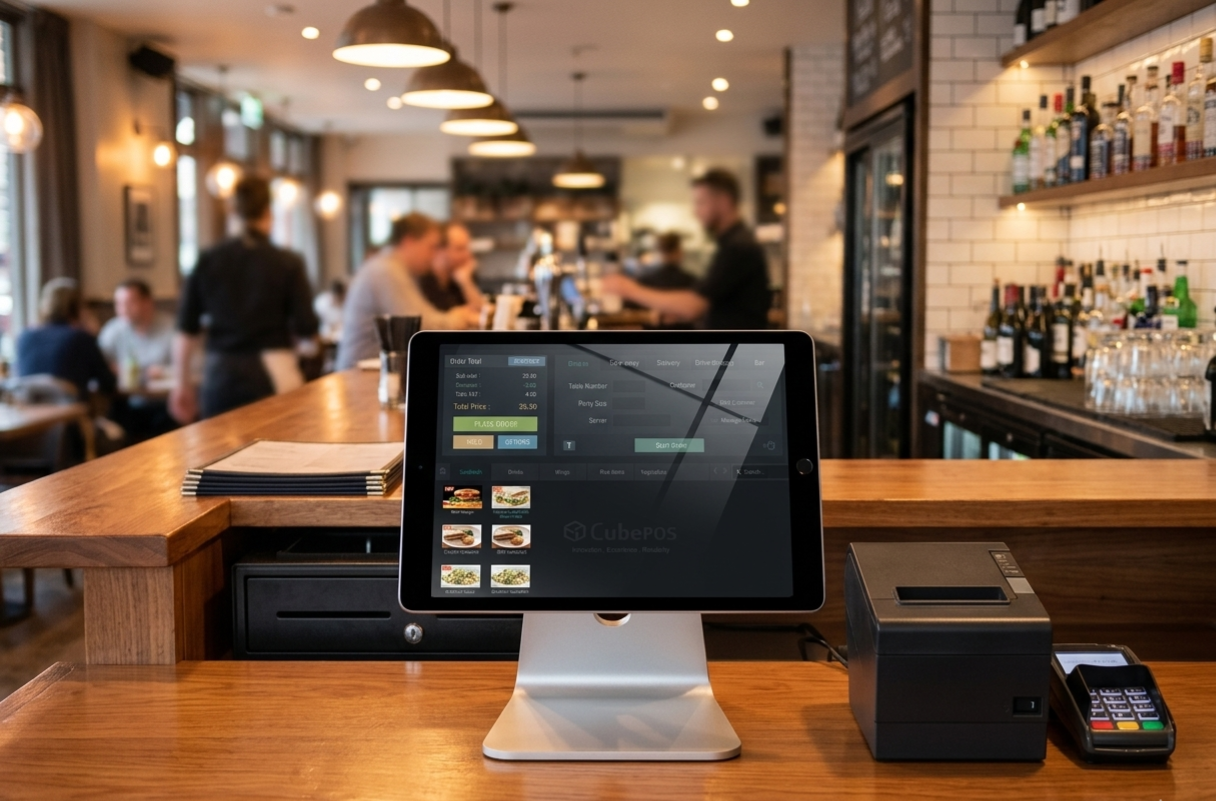
Food costs are the single largest controllable expense in any restaurant business. For UK operators already navigating high energy bills, rising wages, and persistent ingredient price inflation, getting stock management right is no longer a nice-to-have — it is a survival skill. Yet the majority of independent UK restaurants still rely on manual stock counts, spreadsheets, and gut instinct to manage their inventory. The result is predictable: over-ordering, unnecessary waste, running out of key ingredients mid-service, and a complete inability to pinpoint exactly where the money is going.
Restaurant inventory management software changes all of that. When it is properly integrated with your restaurant point of sale system, it turns stock control from a time-consuming manual chore into an automatic, accurate, and genuinely useful part of running your business. This guide explains what restaurant inventory management software is, what it does, how it integrates with your POS system, and how to choose the right solution for your UK food business in 2026.
What Is Restaurant Inventory Management Software?
Restaurant inventory management software is a digital system that tracks every ingredient and product in your kitchen and stockroom, in real time, from the moment it arrives through delivery to the moment it leaves as a finished dish. At its most basic level, it replaces the clipboard and the manual stock count. At its most sophisticated, it is a fully automated system that updates your inventory with every order placed, alerts you when stock falls below reorder thresholds, identifies variance between theoretical and actual usage, and generates purchasing reports that tell you exactly what to order and when.
In the context of a modern UK restaurant operation, the most powerful restaurant inventory management software is not a standalone application — it is a feature built directly into your restaurant point of sale system. When your POS and your inventory management are integrated in a single platform, every order taken at the table or counter automatically reduces your stock levels at the ingredient level. There is no manual data entry, no end-of-day update process, and no gap between what your kitchen is cooking and what your stock records show.
For UK restaurants, cafés, and takeaways operating under margin pressure in 2026, this level of real-time accuracy is not a luxury. It is what separates a business that genuinely controls its food costs from one that is simply hoping for the best.
Why Manual Stock Control Is Costing UK Restaurants Money
Before understanding the value of restaurant inventory management software, it is worth being specific about the cost of not having it. Manual stock control — whether that means weekly clipboard counts, spreadsheet tracking, or simply ordering based on memory — has well-documented weaknesses that directly impact profitability.
Over-ordering and spoilage. Without accurate data on actual usage rates, most restaurants order more than they need. Perishable ingredients that are not used in time become waste — waste that represents money spent with nothing to show for it. UK restaurants that move from manual to automated inventory management consistently report significant reductions in food waste within the first months of using the system.
Running out of ingredients mid-service. The opposite problem is equally costly. Running out of a popular dish during a Friday evening service disappoints customers, frustrates kitchen staff, and can damage your reputation. Real-time stock tracking with low-stock alerts eliminates this entirely — you know what is running low before it becomes a problem.
Undetected theft and shrinkage. Without systematic tracking, it is almost impossible to identify theft, over-portioning, or unauthorised consumption. Restaurant inventory management software with variance reporting compares what should have been used based on orders placed against what was actually used, flagging discrepancies automatically for management review.
Inability to cost dishes accurately. Pricing a menu without accurate ingredient cost data is guesswork. If your food costs creep up because supplier prices have increased but your dish-level costs have not been recalculated, your margins erode silently. Inventory management software that tracks ingredient prices and calculates dish-level cost of goods sold gives you the data to price confidently and respond quickly when input costs change.
Time wasted on manual counts. A weekly manual stock count in a busy UK restaurant kitchen can take two to four hours of a manager's or chef's time. Automated inventory tracking reduces this to a brief variance check, freeing up your most experienced and expensive people to focus on food quality and team management instead.
How Restaurant Inventory Management Software Works
Understanding how the software actually functions helps operators evaluate options more effectively and set realistic expectations for what the system will and will not do automatically.
The foundation of any restaurant inventory management system is the recipe or bill of materials — a digital record of every ingredient used in every dish, in the exact quantity specified in the recipe. Once these recipes are built into the system, every time an order is placed through the point of sale, the system automatically deducts the corresponding ingredient quantities from your stock levels.
A customer orders a ribeye steak with chips and a side salad. The system immediately deducts one ribeye steak portion, the calculated weight of potatoes for the chips, the salad leaf mix, and every other ingredient specified in those recipes from your live inventory. This happens in real time, with no manual input required, for every order placed across every table, every counter, and every online channel.
The result is a continuously updated, accurate picture of your stock levels at any moment. You can see exactly how much of every ingredient you have on hand, which items are approaching reorder level, and how usage is trending compared to previous periods — all from your management dashboard, on any device.
Most restaurant inventory management platforms also handle goods received. When a delivery arrives from your supplier, it is logged into the system — either manually by scanning delivery notes or automatically via integration with your supplier's ordering platform — and your stock levels are updated accordingly. This creates a complete audit trail from delivery to dish.
Key Features to Look for in Restaurant Inventory Management Software
Not all inventory management solutions offer the same depth of functionality. When evaluating options for a UK restaurant, café, or takeaway, the following features distinguish comprehensive, genuinely useful systems from basic stock-counting tools.
Ingredient-level tracking. The system must track stock at the individual ingredient level, not just at the finished dish or product level. Knowing you have fourteen portions of beef stew is useful. Knowing you have 4.2 kilograms of braising steak, 800 grams of carrots, and two litres of red wine stock is actionable. Ingredient-level tracking is what enables accurate recipe costing, waste analysis, and reorder management.
Real-time POS integration. Inventory should update automatically with every order placed through your point of sale system. Manual batch updates introduce delays and inaccuracies. Real-time integration is the feature that makes automated inventory management genuinely reliable.
Recipe and menu management. The ability to build and maintain digital recipes with precise ingredient quantities and unit costs, linked directly to your POS menu. When ingredient prices change, the system should recalculate dish-level food costs automatically.
Automatic reorder alerts. Configurable low-stock thresholds that trigger alerts — by email, SMS, or in-app notification — when any ingredient falls below a defined level. This eliminates running out of key items mid-service and supports more systematic, less reactive purchasing.
Variance and waste reporting. A comparison between theoretical usage (based on orders placed) and actual usage (based on stock counts) reveals shrinkage, over-portioning, and waste. This variance report is one of the most valuable outputs of any inventory management system because it tells you specifically where your food costs are higher than they should be.
Supplier management and purchase ordering. The ability to manage supplier contacts, pricing, and order history within the system, and to generate and send purchase orders directly from the inventory platform. This closes the loop between stock levels, purchasing decisions, and delivery records.
Multi-location stock management. For restaurant groups and multi-site operators, the ability to track and report on inventory across all locations from a single dashboard, with the option to transfer stock between sites.
Food cost and gross profit reporting. Automatic calculation of food cost percentage and gross profit per dish, per category, and per period — linked to actual sales data from your POS system. This is the reporting that enables genuine menu engineering and informed pricing decisions.
Waste logging. A simple interface for kitchen staff to log waste, spoilage, and staff meals as they occur, keeping your theoretical and actual stock figures in alignment and providing accurate data for waste reduction initiatives.
Cloud-based access. Management dashboards accessible from any device, allowing owners and head chefs to monitor stock levels, review variance reports, and approve purchase orders from anywhere — not just from a back-office computer on site.
Restaurant Inventory Management and Your POS System: Why Integration Matters
The most important decision in choosing restaurant inventory management software for a UK food business is whether it integrates with your point of sale system — and how deeply.
A standalone inventory management application that is not connected to your POS requires manual data entry to record what has been sold. This introduces delay, human error, and the ongoing administrative burden of maintaining two separate systems in sync. In a busy restaurant environment, this simply does not happen accurately or consistently, which undermines the value of the inventory data entirely.
When restaurant inventory management software is built directly into your restaurant point of sale system — or deeply integrated with it via a real-time API — the entire process becomes automatic. Sales data flows from the POS to the inventory system continuously. Stock levels are always current. Variance reports are always based on accurate sales data. And your management team spends time acting on insights rather than entering data.
For UK restaurant operators evaluating a new POS system in 2026, choosing a platform that includes native inventory management is the most efficient and cost-effective approach. It eliminates the integration complexity of connecting two separate systems, reduces the number of software subscriptions you are managing, and ensures that your sales data and stock data are always perfectly aligned.
A restaurant EPOS system with built-in ingredient-level stock management is not a specialist product for large restaurant groups — it is the practical choice for any UK food business that takes food cost control seriously.
Restaurant Inventory Management by Venue Type
The specific way inventory management software is used varies significantly depending on the type of food business. Here is how the functionality applies across the most common UK restaurant formats.
Full-Service Restaurants
For full-service restaurants, ingredient-level tracking across a multi-course menu is the core use case. Recipe management allows the kitchen team to maintain precise portion standards, while variance reporting gives the head chef and owner clear visibility of where food costs are running over budget. Daily stock level dashboards replace the weekly manual count, and purchase order management streamlines the relationship with key suppliers.
Cafés and Coffee Shops
Cafés have a high number of individual ingredients across a relatively fast-turning menu — coffee beans, milk, syrups, pastries, sandwich fillings, and salad components all need tracking. A café inventory management system that updates in real time with every transaction and generates daily waste reports helps café operators maintain tight cost control without the administrative overhead of manual tracking.
Takeaways and Fast Food
UK takeaways often operate with large menus, high transaction volumes, and significant ingredient overlap between dishes. Inventory management software that tracks shared ingredients across multiple menu items — base sauces used across a range of Indian curries, for example, or dough across a full pizza menu — gives takeaway operators precise visibility of their most critical ingredient costs. Automatic reorder alerts are particularly valuable in takeaway environments where running out of a core ingredient can mean taking a popular item off the menu at short notice.
Restaurant Groups and Multi-Site Operations
For multi-location restaurant operators, centralized inventory management is transformative. A group-level dashboard showing stock levels, food cost percentages, and waste data across all sites simultaneously allows operations managers to identify which locations are performing well and which need support. Inter-site stock transfers, centralized supplier management, and standardized recipe libraries across all locations are all enabled by a multi-site inventory management platform.
Ghost Kitchens
Ghost kitchens running multiple virtual brands from a single kitchen have complex inventory requirements — the same physical ingredient may appear across several different branded menus. Restaurant inventory management software that tracks ingredient usage across multiple virtual concepts and reports on food cost by brand gives ghost kitchen operators the clarity to manage profitability across each concept independently.
Food Cost Control: What Good Inventory Management Looks Like in Practice
Understanding the practical impact of restaurant inventory management software helps operators assess whether the investment is justified for their specific business.
A straightforward example illustrates the value clearly. Consider a UK restaurant spending £15,000 per month on food purchases. If that restaurant is currently running a food cost percentage of 33% and the industry benchmark for its format is 28%, the gap represents approximately £750 per month in excess food costs — likely a combination of over-portioning, waste, ordering inefficiency, and undetected shrinkage.
Restaurant inventory management software with variance reporting would identify exactly where that gap exists. If the variance report shows that actual beef usage is consistently 12% above theoretical usage based on sales, that points to over-portioning or shrinkage at the meat station. If salad waste logging shows consistent end-of-day spoilage, that points to over-ordering of perishable produce. Each identified issue can be directly addressed, and the impact of any corrective action is immediately visible in the data.
For a business spending £15,000 per month on food, reducing food cost percentage from 33% to 29% represents £600 per month in additional gross profit — or £7,200 per year. Against a software cost of £50 to £100 per month as part of a restaurant POS subscription, the return on investment is straightforward to calculate.
Choosing Restaurant Inventory Management Software for a UK Business
When selecting inventory management software for your UK restaurant, café, or takeaway, the following criteria should guide your decision.
Prioritise native POS integration over standalone applications. A system that is built into your restaurant point of sale will always deliver more accurate, more timely data than one that requires manual synchronisation or periodic data exports.
Confirm ingredient-level tracking rather than product-level tracking. Some basic stock systems track finished products rather than individual ingredients. This is useful for a retail business but inadequate for a restaurant kitchen where a single dish uses multiple ingredients in specific quantities.
Assess the ease of recipe building. If building and maintaining recipe records in the system is complex or time-consuming, it will not be maintained accurately. The best systems make recipe management simple enough for a head chef or kitchen manager to do themselves, without specialist technical knowledge.
Check for UK-specific reporting. Food cost reporting should work in pounds and pence, handle UK VAT correctly, and generate outputs compatible with UK accounting software. A system designed for another market and adapted for the UK will often have gaps in reporting functionality that create additional work.
Evaluate supplier management capability. A system that can manage your supplier list, record delivery prices, and generate purchase orders saves significant administrative time and creates a clear record of purchasing history that is invaluable during supplier price negotiations.
Ask about multi-site capability from the outset. Even if you currently operate a single site, choose a platform that can scale to multi-location management without requiring a system change. Growing into a second site should be a straightforward configuration change, not a platform migration.
Frequently Asked Questions
What is restaurant inventory management software?
Restaurant inventory management software is a digital system that tracks your ingredients and stock in real time, automatically updating as orders are placed and deliveries are received. When integrated with your restaurant point of sale system, it eliminates manual stock counting, reduces food waste, identifies shrinkage, and gives you accurate food cost data at the dish and period level.
Does restaurant inventory management software integrate with my POS system?
The best restaurant inventory management solutions are either built directly into a restaurant point of sale system or integrate with it via a real-time connection. This means your stock levels update automatically with every sale, without any manual input. Always confirm the depth of POS integration before choosing a standalone inventory management application.
How does inventory management software reduce food waste?
By tracking exactly what is used against what was ordered, inventory management software identifies over-ordering, over-portioning, and end-of-day spoilage. Low-stock alerts help you order more precisely. Waste logging tools allow kitchen staff to record and categorize waste as it happens. Variance reports show management exactly where actual usage differs from what recipes specify, enabling targeted corrective action.
Can small UK restaurants and takeaways afford inventory management software?
Yes. When inventory management is included as part of a restaurant point of sale system subscription, the combined cost for a small UK restaurant or takeaway typically starts from around £50 to £80 per month — far less than most operators spend on food waste in a single week. The return on investment for any food business spending more than £5,000 per month on ingredients is typically achieved within the first two to three months of use.
What is food cost variance and why does it matter?
Food cost variance is the difference between your theoretical food cost — what your recipes say should have been used based on orders placed — and your actual food cost, based on what stock was actually consumed. A positive variance (using more than expected) indicates over-portioning, waste, or shrinkage. Monitoring variance regularly is one of the most effective ways to identify and address food cost problems before they materially impact profitability.
Does restaurant inventory management software work for multi-site operations?
Yes. The best restaurant inventory management platforms include multi-site capability, with a centralized dashboard showing stock levels, food cost, and waste data across all locations simultaneously. Group-level recipe libraries, inter-site stock transfers, and consolidated supplier management are all standard features in multi-site systems.
How long does it take to set up restaurant inventory management software?
The most time-consuming part of setup is building your recipe library — entering each dish with its precise ingredient quantities and unit costs. For a mid-sized UK restaurant with a menu of fifty to eighty dishes, this typically takes one to two days. Once recipes are built, the system runs automatically. Most providers offer on-boarding support to help with the initial setup process.
Conclusion
For UK restaurants, cafés, and takeaways in 2026, food cost control is not a finance function — it is an operational priority that affects every service, every menu decision, and the long-term viability of the business. Manual stock management is no longer adequate in an environment where ingredient prices are volatile, margins are thin, and the cost of waste and inefficiency is simply too high to absorb.
Restaurant inventory management software — particularly when it is integrated directly into your restaurant point of sale system — gives UK food businesses the real-time visibility, the accurate data, and the actionable reporting they need to take genuine control of their food costs. It replaces guesswork with precision, manual counting with automation, and end-of-month surprises with daily insight.
Our restaurant point of sale system includes built-in ingredient-level inventory management designed specifically for UK restaurants, cafés, and takeaways. From automatic stock depletion with every sale to variance reporting and purchase order management, everything you need to control your food costs is included in a single, affordable platform built for the UK market. Get in touch today to see how it works in practice.