
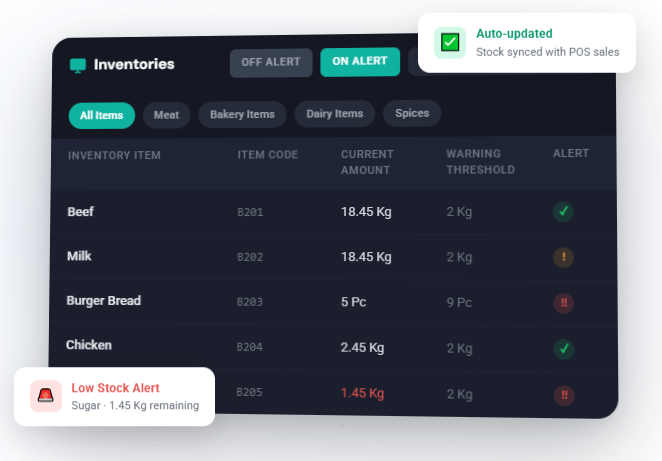
Food costs are one of the biggest controllable expenses in any restaurant. Yet for most operators, the full picture of what is being used, wasted, or lost remains stubbornly out of reach — buried in spreadsheets, paper stock counts, and a pile of supplier invoices that never quite reconcile. The result is margin leakage that compounds quietly, week after week, until it starts showing up in your bottom line.
Modern restaurant inventory management software changes this entirely. By connecting your point of sale system, your recipes, and your supplier ordering into a single real-time platform, it gives you complete visibility over your food costs, your stock levels, and your profitability — from anywhere, at any time. This guide covers what restaurant inventory software actually does, the features that matter most for UK operators in 2026, and why an integrated approach through CubePOS is the smartest choice for restaurants serious about protecting their margins.
Why Restaurant Inventory Management Matters More Than Ever
UK hospitality is operating under intense cost pressure in 2026. Ingredient prices remain volatile, driven by ongoing food inflation and supply chain uncertainty. Wage costs have risen significantly. Energy costs, rent, and rates continue to squeeze margins across the sector. In this environment, even small improvements in food cost control can make a substantial difference to profitability.
Research from the hospitality sector consistently shows that restaurants relying on manual inventory processes — clipboards, spreadsheets, and occasional stock counts — fail to catch the margin leakage that accumulates through waste, over-ordering, portion drift, supplier price changes, and unrecorded breakages or theft. For a restaurant turning over £500,000 per year, even a 2 to 3 percent improvement in food cost control can represent £10,000 to £15,000 in additional profit annually.
Manual stock control creates blind spots. If your team only discovers a supplier price increase when it appears in your monthly accounts, the damage has already been done. If you only know you have run out of a key ingredient when a customer orders it, you have already lost the sale. Effective restaurant inventory management software replaces these reactive processes with real-time, automated tracking that keeps you ahead of the numbers instead of chasing them.
What Is Restaurant Inventory Management Software?
Restaurant inventory management software is a digital system that automates the tracking, counting, ordering, and costing of every ingredient and item in your restaurant. It replaces manual spreadsheets and paper-based processes with a connected platform that updates stock levels in real time, links directly to your POS system, and gives you accurate, up-to-date data on your food costs, waste, and profitability at all times.
At its most effective, restaurant inventory software integrates with your point of sale so that every item sold automatically depletes the relevant ingredients from your stock count. It connects to your supplier network so that purchase orders can be generated and sent electronically. It tracks actual usage against theoretical usage — the stock you should have used based on sales — so that variances caused by waste, portion inconsistency, spillage, or theft are immediately visible.
This shift from delayed, manual reporting to proactive, real-time management is the foundation of effective food cost control in the modern restaurant.
The Real Cost of Poor Inventory Control
Many restaurant operators underestimate how much poor inventory control is costing them. The losses are rarely dramatic enough to trigger immediate alarm — they accumulate gradually, across multiple categories, in ways that are difficult to attribute without proper tracking in place.
Food Waste
Over-ordering perishables, incorrect portion sizes, and items that spoil before they can be used represent direct, preventable losses. Without real-time stock visibility, it is impossible to order accurately or to identify which items are being over-prepared and discarded. Food waste management is not just a cost issue — it is an increasingly important sustainability concern for UK hospitality businesses.
Portion Drift and Recipe Inconsistency
When chefs prepare dishes without consistent portion guidance, the actual cost of each dish gradually diverges from its theoretical cost. A recipe that looks profitable on paper can quietly become unprofitable when portions are consistently larger than specified. Restaurant inventory software that tracks actual versus theoretical usage makes this visible immediately, allowing managers to address the issue before it becomes a significant cost.
Supplier Price Changes
Ingredient prices change constantly. A supplier quietly increasing the price of a key ingredient by five percent can meaningfully affect the profitability of the dishes that rely on it — but only if you catch it. Manual invoice processing rarely provides this level of granularity in real time. Automated invoice scanning and real-time price alert features in modern inventory software ensure that price changes are flagged immediately, allowing you to renegotiate, switch suppliers, or adjust menu pricing accordingly.
Theft and Shrinkage
Unrecorded usage, unauthorised consumption, and deliberate theft are rarely visible without a system that tracks actual versus theoretical inventory usage. Variance reports that highlight discrepancies between what should have been used and what was actually used are one of the most effective tools available for identifying and addressing shrinkage across food and beverage operations.
Key Features of Effective Restaurant Inventory Management Software
Not all inventory management tools are built to the same standard. These are the features that genuinely move the needle on food cost control and operational efficiency for UK restaurants.
Real-Time Stock Tracking
The foundation of any inventory management system is real-time visibility over stock levels. Every time an item is sold, stock should be automatically depleted at the ingredient level. Every time a delivery is received, stock should be updated immediately. This eliminates the need for manual stock counts as your primary source of truth, and ensures that your inventory data is always current.
Ingredient-Level Tracking and Recipe Costing
The most powerful inventory systems track stock not just at the product level but at the ingredient level — meaning that selling a dish automatically deducts each of the individual ingredients that go into it, in the correct quantities. This is what makes genuine food cost analysis possible. EPOS with ingredient level tracking allows you to calculate the exact cost of every dish on your menu, identify your most and least profitable items, and make informed decisions about pricing and menu engineering based on real data.
Actual vs Theoretical Variance Reporting
Variance reporting compares the theoretical stock usage — what should have been used based on sales and recipes — against actual physical stock counts. The difference between the two is your variance, and it reveals where your losses are occurring: waste, over-portioning, theft, spillage, or simple counting errors. Accessing this data regularly is one of the most powerful tools available for protecting food cost margins.
PAR Level Management and Automated Ordering
PAR (Periodic Automatic Replenishment) levels define the minimum stock quantity for each ingredient before a reorder is triggered. Inventory software that tracks PAR levels automatically alerts you when stock falls below the threshold and can generate purchase orders directly to your suppliers, reducing the time spent on manual ordering and the risk of running out of key ingredients during service.
Supplier Management and Invoice Processing
Modern restaurant inventory systems connect directly with your supplier network, allowing you to manage purchase orders, receive deliveries, and reconcile invoices within a single platform. Automated invoice scanning extracts price data and updates your ingredient cost database automatically, sending alerts when prices deviate from expected levels. This dramatically reduces the administrative burden of supplier management and ensures that cost changes are captured in real time.
Waste Tracking and Logging
Recording waste — whether from spoilage, preparation, or service — is essential for accurate inventory counts and for identifying where losses can be reduced. Good inventory software makes waste logging quick and easy for kitchen staff, capturing the data needed to understand where food is being lost and quantifying its cost impact.
POS Integration
The most important integration for any restaurant inventory system is with your point of sale. When inventory software is directly connected to your POS, every sale automatically updates your stock levels in real time, without any manual intervention. This is what makes true real-time tracking possible and eliminates the inaccuracy that builds up when stock updates are performed manually or infrequently.
Cloud-Based Accessibility and Reporting
Cloud-based inventory management allows you to access your stock data, cost reports, and supplier information from any device and any location — whether you are in the restaurant, at the market, or working remotely. This is particularly valuable for multi-site operators who need visibility across multiple locations from a single dashboard. A cloud POS system for restaurants UK that includes built-in inventory management eliminates the complexity and cost of running separate software platforms and ensures that your POS and stock data always work from the same source of truth.
Allergen and Nutritional Compliance
UK food allergen regulations require restaurants to provide accurate information about the 14 major allergens in every dish they serve. Inventory software that tracks allergen information at the ingredient and recipe level makes compliance significantly easier, reducing the risk of errors and providing a clear audit trail for each menu item.
Multi-Site Management
For restaurant groups and chains, centralised inventory management across multiple locations is one of the highest-value capabilities available. The ability to view stock levels, compare food costs, standardise recipes, and manage supplier relationships across all sites from a single platform saves significant time and gives head office the visibility needed to identify performance gaps and manage costs at scale.
The Problem with Manual Inventory Processes
Most independent UK restaurants still rely on some combination of spreadsheets, paper stock sheets, and manual counting to manage their inventory. This approach has fundamental limitations that make accurate, real-time food cost management almost impossible.
Manual stock counts are time-consuming, error-prone, and only capture a snapshot of your inventory at one point in time. By the time you have counted everything, reconciled it against your purchase records, and worked out your usage figures, the data is already out of date. Spreadsheets require manual data entry at every stage, introducing errors that compound over time and making it difficult to produce reliable cost analysis. Manual ordering is reactive rather than predictive, leading to over-ordering on some items and stockouts on others.
More fundamentally, manual processes cannot generate the kind of real-time, granular insight that effective food cost management requires. You cannot identify actual versus theoretical variance if you only count stock once a week. You cannot catch supplier price increases if you are processing invoices manually once a month. You cannot see which dishes are profitable and which are not if your recipe costs are based on ingredient prices that were entered into a spreadsheet six months ago.
The shift from manual to automated inventory management is not just about saving time. It is about gaining the data quality needed to make genuinely informed decisions about your restaurant's profitability.
How CubePOS Integrates Inventory Management into Your Restaurant POS System
CubePOS is a restaurant POS system built specifically for UK hospitality operators, with inventory management built directly into the platform rather than bolted on as an afterthought. This integrated approach means that your point of sale and your stock management always work from the same data, without the complexity or cost of connecting separate software systems.
Real-Time Stock Deduction from Sales
Every item sold through CubePOS automatically updates your stock levels in real time, at the ingredient level. This means your inventory data is always current, always accurate, and always reflects exactly what has been sold and what remains in stock — without any manual intervention from your team.
Ingredient-Level Recipe Management
CubePOS allows you to build and manage recipes at the ingredient level, specifying exact quantities and portion sizes for every dish on your menu. As items are sold, each ingredient is automatically deducted in the correct quantity, giving you a precise, real-time view of theoretical stock usage that can be compared against physical counts to identify variance.
Low Stock Alerts and Reorder Notifications
Set PAR levels for every ingredient in your kitchen and CubePOS will alert you automatically when stock falls below the threshold. This ensures that your team never runs out of key ingredients during service, and that ordering decisions are based on real stock data rather than guesswork or habit.
Food Cost and Profitability Reporting
CubePOS generates detailed food cost reports that show the cost of goods sold (COGS) for every dish, your overall food cost percentage, and a clear breakdown of your most and least profitable menu items. This data is updated in real time and accessible from any device, giving you the insight needed to make informed decisions about menu pricing, portion sizes, and ingredient sourcing.
Waste and Variance Tracking
Record waste quickly and easily within the CubePOS platform, capturing the data needed for accurate stock reconciliation and cost analysis. Variance reports highlight the difference between theoretical and actual usage, making it easy to identify where losses are occurring and take action to address them.
Integrated with Your POS and Supplier Workflow
Because inventory management is built directly into CubePOS rather than operating as a separate system, there is no data transfer delay, no reconciliation required between platforms, and no risk of your stock data and your sales data falling out of sync. Everything works from a single source of truth, giving you confidence in the accuracy of every report and every cost calculation.
Choosing the Right Restaurant Inventory Management Approach for Your Business
The right inventory management solution depends on the size and complexity of your operation. Smaller independent restaurants and cafés typically benefit most from an integrated approach where inventory management is built into their POS system, avoiding the cost and complexity of a separate dedicated inventory platform. Larger multi-site operations or those with complex supply chains may benefit from more specialised dedicated inventory software connected via integration to their POS.
Whichever approach you take, the key principles are the same: you need real-time stock tracking, ingredient-level recipe costing, actual versus theoretical variance reporting, and direct integration with your point of sale. Without these fundamentals, effective food cost management is not possible.
When evaluating options, ask potential providers to demonstrate how stock is updated when a sale is made, how variance reports are generated, how supplier invoices are processed, and how the system performs when internet connectivity is unavailable. The answers to these practical questions will tell you far more about the real-world suitability of a system than any feature list.
What to Expect When You Switch to Integrated Inventory Management
Operators who move from manual or spreadsheet-based inventory management to a properly integrated system consistently report the same outcomes: more time saved on stock counting and ordering, greater accuracy in food cost reporting, faster identification of waste and variance issues, and a clearer view of which menu items are genuinely profitable.
The transition itself is straightforward when managed properly. Building your recipe library within the system is the most time-intensive initial step, but once complete, the ongoing maintenance is minimal. Most teams achieve comfortable operational proficiency within the first few weeks, and the data quality improvements are evident almost immediately.
For UK restaurants operating under continued cost pressure in 2026, the investment in proper inventory management software pays for itself many times over in recovered margin, reduced waste, and better purchasing decisions.
Conclusion: Take Control of Your Food Costs with CubePOS
Food cost control is not a back-office task — it is a core business discipline that determines whether a restaurant is profitable or not. Manual inventory processes leave too many blind spots, introduce too many errors, and simply cannot provide the real-time data that modern restaurant management requires.
CubePOS gives UK restaurant operators an integrated, purpose-built solution that connects point of sale, inventory management, recipe costing, and food cost reporting into a single, seamless platform. Whether you run an independent restaurant, a busy takeaway, a café, or a growing multi-site group, CubePOS gives you the visibility and control you need to manage your costs, reduce your waste, and protect your margins in 2026 and beyond.
Ready to take control of your inventory and your food costs? Explore CubePOS inventory management features and speak to the team today.